MURYOKO

'Infinite Light'
Journal of Shin Buddhism
Hisao (Zuio) Inagaki
The Six Aspects of the Shin Educational Process - Man's Encounter with Amida
Contents
The Six Aspects As the Process of Spiritual Development
The Sixth Aspects as the Essence of Shinjin
Interrelations of the Six Aspects
Introduction
Man is an empirical and finite being in the sense that he is confined to the sphere of sense-perceptions and his existence is limited to both temporal and spatial dimensions. Religious pursuit of truth starts with man's encounter with the transcendent and infinite, in whatever meanings these terms may be interpreted. In Buddhism, the transcendent is seen in the light of personal and impersonal aspects, namely, Buddha and Dharma. The transcendent Buddha and Dharma constitute the content of enlightenment (satori), the goal for all Buddhists. The enlightenment-truth is not a static principle but a dynamic force which works spontaneously on both the plane of transcendent reality and that of empirical fact.
In Shin, the infinite (amita) is represented by Amida, the Buddha of Infinite Light and Life. With transcendent wisdom (reality- knowledge) and all-embracing compassion (unrestricted assimilative power), Amida approaches man, making the encounter with the transcendent and the infinite possible. Though he has provided various ways of spiritual encounter for people of various propensities, they eventually lead to the ultimate path of salvation - the Nembutsu Faith.
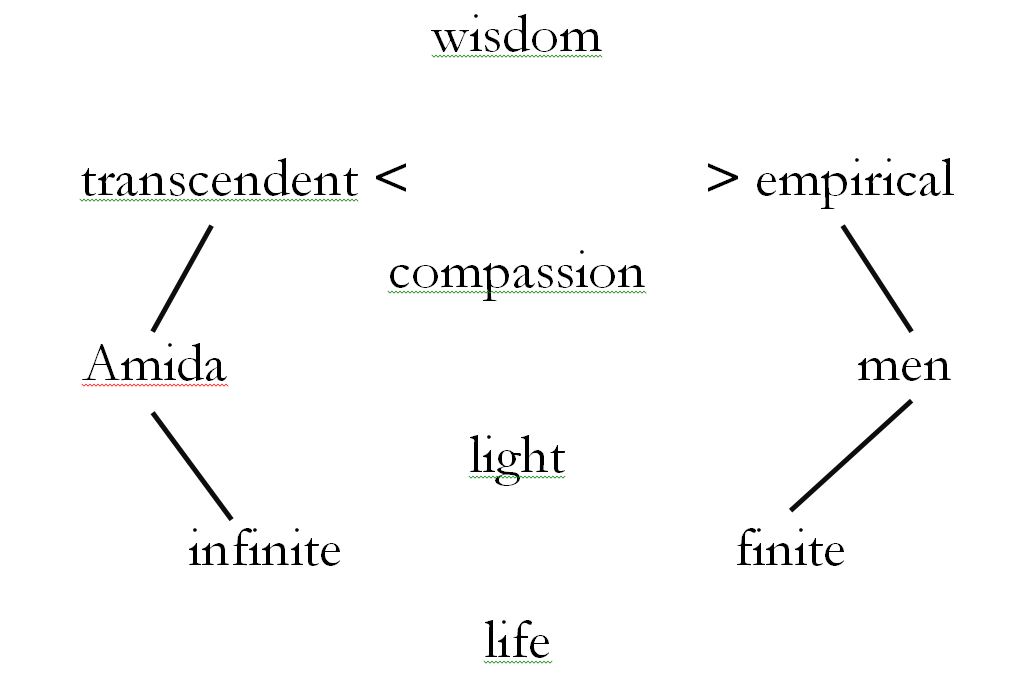
The all-embracing compassion of Sakyamuni and Amida
Has awakened in me the aspiration to become a Buddha;
Having been endowed with the transcendent wisdom of faith,
I gratefully acknowledge the Buddhas' benevolence.
- Shozomatsu Wasan
The Six Aspects As the Process of Spiritual Development
The Six Aspects are the natural process of spiritual development for those who encounter Amida.
(1) Expanding: One opens one's heart to a possibility of infinite growth with enlightenment as the goal. The first step is "hearing" the Dharma, which leads to "thinking" deeply and then to "accepting" what Amida offers. Contact with Amida, in whatever way it may be made - whether visually by seeing a picture or statue, or aurally by hearing the Name - serves to expand one's spiritual horizon.
When one hears Amida's Name, rejoices in faith even once - through his empowerment - and aspires to be born in his land, one will quickly attain birth and dwell in the stage of non-retrogression.
- Larger Sutra
The right practice is fivefold: to chant the Pure Land sutras with singleness of mind; to meditate and think deeply on Amida and his land; to worship Amida with singleness of heart; to recite his Name with singleness of mind; and to admire and praise his virtue and make offerings to him with singleness of mind.
- Shan-tao, Sanzen Gi
(2) Self-reflection: Expanding is accompanied by self-reflection, which is an inward journey to explore what is within one's self. Self is, so to speak, seen reflected in the mirror of transcendent wisdom. One is driven by Amida to look deep inside one's self. Thus, Self-reflection reveals deeper and deeper parts of self until all the content is exposed. Self-reflection leads to awareness of one's karma - psycho-physical energy - which has created and recreated one's existence since the beginningless past and is continually working underneath one's consciousness without a moment's rest. Too often karma is ignored, left to run its course unbridled. To achieve a healthy expansion of one's self, it is essential to control one's karma and redirect it towards enlightenment. Self-reflection reveals the reality of one's karma.
Deep Mind is twofold: to believe deeply, I am an unenlightened man, full of evil passions and subject to cycles of birth-and-death; I have been constantly sunk in the sea of samsara, without finding a chance to attain deliverence...
- Shan-tao, Sanzen Gi
All living beings, since the beginningless past, have been transmigrating in the sea of ignorance, drowning in the cycle of existences, bound to all sorts of sufferings, and having no pure, serene faith.
- Shinran: Kyogyoshinsho, chap. on Faith
How sad it is that I am sunk in the vast sea of greed and attachment and lost in the great mountain of desire for fame and profit.
- Ibid.
Since I am not capable of any religious practice whatsoever, hell is definitely my dwelling place.
- Tannisho
(3) Awakening to Great Compassion: When one's self is completely exposed and there is a deep awareness of karma and one's powerlessness to control it, one is fully awakened to Amida's all - embracing Compassion through his wisdom and power. In other words, Great Compassion makes its presence known by revealing one's entire existence in the light of the transcendent wisdom and with the control of one's karma with the universal, pure karmic power which Amida has attained through his Vow and practice. Serene Faith (shinjin) is awareness of and awakening to Great Compassion. More precisely, it is Great Compassion itself transferred to man. It is through awakening to Great Compassion that one encounters Amida in the true sense of the term.
Serene Faith is the vast, ocean-like mind, in which Amida's perfect Great Compassion is fulfilled and his all complete virtue is consummated. .. . Since this faith is Amida's Great Compassion itself, it is without doubt the cause of birth in the Pure Land.
- Shinran, Kyogyoshinsho, chap. on Faith
This mind is the pure and true Serene Faith consummated by the Vow. It is called shinjin. Shinjin is the mind of Great Compassion; hence, it is not mingled with doubt.
- Shinran, Monruijusho
(4) Great Joy: Joy of encountering Amida, the transcendent and the infinite, is the feeling of ultimate fulfillment and contentment. It is a "pure" emotion in the sense that it is not mixed with self - centered illusory passions.
the true One Mind is the mind of Great Joy; the mind of Great Joy is the true shinjin....
- Kyogyoshinsho, chap. on Faith
When one hears Amida's Name, rejoices in faith even once....
- Larger Sutra
When ordinary, unenlightened beings, who are eternally sunk in samsara, hear through the Vow's empowerment the Name of true virtue and attain the supreme faith, they will have great joy and dwell in the stage of non- retrogression.
- Monruijusho
Those still clinging to self-power while outwardly entrusting themselves to Amida's power fail to attain Great Joy.
Those who perform the exclusive Nembutsu practice while entertaining mixed and divided minds do not have Great Joy.
- Kyogyoshinsho, chap. on Transformed Buddha
(5) Gratitude: Great Joy gives rise to gratitude, a desire to express in words and actions one's gratefulness and indebtedness to Amida.
He who has attained the adamantine True Mind ... is sure to enjoy ten kinds of benefit in the present life. They are: ... (8) acknowledging Amida's benevolence and desiring to repay it; (9) always practicing Great Compassion; and (10) joining those who are assured of birth in the Pure Land and attainment of enlightenment.
- Kyogyoshinsho, chap. on Faith
To establish true faith in oneself and teach others to attain it
Is the difficulty of all difficulties;
To convert people everywhere with the heart of Great Compassion
Is the true way of repaying the Buddhas' benevolence.
- Shan-tao, Ojo Raisan
(6) Life of Meaning and Growth: Gratitude is the basis for a life of meaning and growth. It generates power to gear life towards spiritual growth. The Great Compassion which one has received now radiates through life's activities to benefit others. This is the life of the Nembutsu Faith. A man of the Nembutsu Faith is compared to a lotus blossom and is called myokonin, an excellent, wondrous man.
Having expounded Namo Amida Butsu,
Whose virtues are like the ocean water,
I have been given the perfectly pure goodness.
Many other people partake of it.
- Shinran, Koso Wasan
He who sincerely aspires birth in the Land of Bliss acquires the luminous wisdom and the supreme virtues.
- Larger Sutra
A man of the Nembutsu is a lotus blossom among people.
- Meditation Sutra
A man of the Nembutsu is a wondrous man among peo- ple, an excellent, wondrous man, a superior man, a rare man, and a most distinguished man.
- Sanzen Gi
The Sixth Aspects as the Essence of Shinjin
The Six Aspects are the essence of shinjin, and each explains a vitally important part of shinjin.
(1) Shinjin is expanding because it is the opening of one's heart to Amida. Upon receiving shinjin, one's heart expands beyond the limited sphere of ego activity. Shinjin is in itself Amida's infinite wisdom and compassion, which means that a man of shinjin has begun a process of endless expansion. Shinjin as the dynamic, ever-expanding spiritual force is the Bodhi Mind, the resolution to attain enlightenment and save all suffering beings.
Shinjin is the One Mind;
The One Mind is the Adamantine Faith;
The Adamantine Faith is the Bodhi Mind;
This mind is the Other-Power Faith.
- Koso Wasan
the True Faith is the Adamantine Faith; the Adamantine Faith is the aspiration to become a Bud- dha; the aspiration to become a Buddha is the desire to save living beings; the desire to save living beings is the desire to grasp living beings and make them attain birth in the Pure Land of Bliss; this desire is the Great Bodhi Mind
- Kyogyoshinsho, chap. on Faith
(2) Shinjin is a self-reflection because it is the awareness of the absolute sinfulness and powerlessness of the one who receives it. When grasped by Amida, self no longer needs to be hidden away and protected. One now sees one's entire self shone through by the transcendent wisdom and perceives one's whole karma assimilated by Amida's supreme virtue.
The Master used to say, "When I carefully considered the Vow which Amida brought forth after five kalpas contemplation, I find that it was solely for me, Shinran, alone! So, how gracious is the Original Vow of Amida who resolved to save me, burdened with immense karma!" As I now reflect on his reminiscences, they are not a bit different from Shan-tao's golden saying, "know that we are, in reality, unenlightened men, full of evils and subject to cycles of birth-and-death, having been constantly sunk in the sea of samsara since immeasurable kalpas up to the present, and that we have no chance for deliverance."
- Tannisho
Although I have taken refuge in the true Pure Land teaching,
I have no true and sincere mind;
Being so full of falsehood and insincerity,
I am absolutely devoid of pure heart.
- Shozomatsu Wasan
Although the darkness of ignorance has already been rent,
The cloudy mists of greed, covetousness, anger and hatred
Always blanket the sky of True Faith.
- Shinran, Shoshinge
(3) Shinjin is awakening to Great Compassion because it is Amida's heart transferred to man. To be more precise, Shinjin is itself Great Compassion.
Shinjin is the mind of Great Compassion; hence, it is not mingled with doubt.
- Monruijusho
this desire is the Great Bodhi Mind; this mind is the mind of Great Compassion
- Kyogyoshinsho
When the waters of good and evil minds of ordinary, unenlightened men
Have entered the ocean of Amida's Wisdom and Vow, immediately do they change into The mind of Great Compassion.
- Shozomatsu Wasan
(4) Shinjin is Great Joy because it is the pure emotion, free from illusion and undefiled by evil passions. It is also the feeling of ultimate fulfillment and contentment realized in man"s heart through Amida's empowerment.
This shinjin is the mind of Great Compassion and Great Mercy; this shinjin is Buddha-nature; Buddha-nature is Tathagata. To attain this shinjin is to have Great Joy. Those who have Great Joy are said to be equal to Buddhas.
- Shinran, Yuishinsho mon
the mind of Great Joy is the true shinjin
- Kyogyoshinsho, Chap. on Faith
(5) Gratitude is part of shinjin; it is the natural expression of Great Joy in word and action. On one hand, gratitude is expressed as the Nembutsu, and in words in praise of Amida's virtue; on the other hand, it finds its expression in kindness to others, readiness to help them, and so on, with the heart of compassion.
Reverently entrusting myself to the teaching, practice and enlightenment of the true Pure Land path, I am deeply aware of the Buddha's benevolence. I rejoice in what I have heard and praise what I have been given by Amida.
- Kyogyoshinsho, Preface
The right practice is fivefold: ... (4) to recite his Name with singleness and mind; and (5) to admire and praise his virtue and make offerings to him with singleness of mind.
- Sanzen gi
Those who have sincere and true Faith
And keep reciting Amida's Name
Have always the thought of remembering him
And desire to repay his benevolence,
- Shinran, Jodo Wasan
(6) Shinjin is the pure driving force originating in Amida's Vow. It not only gives life meaning and power, but it is the life itself - Amida's infinite life. Man's limited and defiled life-energy has now been turned into the infinite and pure life-energy, which finds its fullest expression in one's efforts to realize one's true self and help others realize theirs.
In the true Pure Land teaching, there are two kinds of eko (empowerment): eko enabling us to go to the Pure Land, and eko enabling us to return to this world (to save suffering beings).
- Kyogyoshinsho, chap. on Teaching
Those who have encountered the Vow-Power
Never pass in vain;
Led into the sea of the treasure of virtues,
The muddy waters of evil passions do not remain unchanged.
- Koso Wasan
As we sail on the ship of the Vow of Great Compassion and float in the vast sea of Light, the breezes of the utmost virtue blow softly and the waves of various evils turn into virtues. Thus, the darkness of ignorance being broken, we shall quickly reach the Land of Infinite Light and attain Great Nirvana. Then, we shall follow the virtue of Samantabhadra to save suffering beings.
- Kyogyoshinsho, chap. on Practice
Interrelations of the Six Aspects
Each preceding aspect is the cause of each following one; each aspect anticipates and leads to the next. The six not only constitute the logical sequences but also are the natural process of spiritual awakening and growth.
The Six Aspects represent a three-stage process of development:
- Expanding and self-reflection are the first steps in the journey of spiritual growth. They are complementary, like centrifugal and centripetal forces together, they prepare one for the true encounter with Amida.
- Awakening to Great Compassion and Great Joy is the essence of the experience of the Nembutsu Faith (shinjin). Here one's heart is completely opened to Amida, and is totally imbued with his Wisdom andCompassion.
- Gratitude and life of meaning and growth are the result of the experience of the Nembutsu Faith. Life of meaning and growth full of gratitude unfolds itself spontaneously. This is a life properly geared toward enlightenment and endless altruistic activities.
- The earlier aspects continue to exist in the later ones. Expanding and self-reflection are not discarded when one awakens to Great Compassion. All work together throughout the whole process, revitalizing one's faith and strengthening one's life-force.
Awakening to Great Compassion is not an experience which passes away as soon as it takes place. Once one's heart is opened to Amida, it never closes. One's life now feeds on Great Compassion, allowing it to renew one's life-energy each moment and activate it towards Bodhi. Any one aspect, when fully developed, contains the remaining five. Expanding, for example, becomes true expanding when one awakens to Great Compassion. Further, true expanding is always accompanied by gratitude. Expanding in the right direction is what is meant by life of meaning and growth.
Why Six?
The Six Aspects show one process of spiritual development with satori (enlightenment) and truly compassionate Bodhisattva activities as the goal. Since one aspect naturally leads to the next and cannot exist independently, the Six Aspects form a nexus of causality. Taken as a whole, they represent a course of controlled and redirected psycho-physical energy (karma), which involves fundamental problems of religious education. The Six Aspects can be condensed to three, as observed above, or two, or even one. Again, since each aspect has a number of phases or stages, the aspects could be subdivided to total well over that.
It is to be noted that "six" is a good number in Shin Buddhism. First of all, it is the number of the Chinese characters for the Name (myogo), pronounced in Japanese na-mu-a-mi-da-butsu, or na- ~no-o-mi-t'o-fo in Chinese. The Kyogyoshinsho has six chapters and Amida's Vows number forty-eight, a multiple of six. Further, as shown above, the Six Aspects can be grouped in three pairs corresponding to the three stages of spiritual development: the preparatory stage leading to shinjin, the stage of awakening of shinjin, and the stage of actualization of shinjin in life. Thus the Six Aspects nicely fit the pattern of action and thinking we are used to. Again, "three" is the number we frequently come across in Shin teaching, as in the three sutras, the three-vow conversion, and the three minds in the Eighteenth Vow.
Tapping the Reserves
Many people live their lives without fully utilizing their hidden powers. School education and higher education are indeed useful in developing man's physical and mental resources, but they are merely made to serve secular purposes. Education in the true sense of the term should aim at the fullest development of man's potential beyond the realm of worldly concerns. Buddhist education, whether collective or individual, leads one to the Bodhisattva Way - the way of realizing the transcendental wisdom and universal compassion.
The first step to be taken is tapping the reserves. Expanding and self-reflection work together to tap the inner resources. This operation is not easy as it sounds. It requires deep and prolonged concentration and enormous courage - concentration on the self and courage to face its true nature. The reserves hidden away from superficial observations are like crude oil, filthy and stinking. They are known in Shin Buddhism as evil because in their "crude" state they are unwholesome, conducive to deepening self-deception and inflicting pain upon oneself and others. Depending upon the degree of concentration and the depth of self-reflection, the inner resources are explored deeply or fleetingly, and the horizon of spiritual life expands accordingly.
In the process of tapping the reserves one runs into a number of obstacles. The biggest of these at the initial stage is resistance, the natural instinct is to defend one's self. Once resistance ceases, one is ready to cooperate with oneself (or with anyone who helps one look into oneself). Still the way is long and progress is slow. Shin Buddhism offers the most effective way of achieving the end.
The Shin Buddhism teaches how, in realizing one's self, one can avail oneself of Amida's wisdom and power. It first offers a vision of the fully expanded self, which is not at all a pleasant picture to look at. The self is completely exposed, along with all its filthy and stinking elements. But the pain of facing one's self is mitigated by Amida's compassion for he embraces it with loving kindness, and dislodges the defiling elements with the skill of an adept physician. When the whole operation is over, self is freed from the bondage of ego-attachment, and all the energy, now absorbed in Amida's pure karma, begins to work to realize the Bodhisattva ideal.
By the virtue of the Unhindered Light
We obtain the Great Path of the supreme merit;
The ice of our evil passions, without fail,
Melts and turns into the water of Bodhi.
Hindrances of evil karma, as in the case of ice and water,
Are the substance of merits and virtues.
The more the ice, the more the water;
The more the hindrances, the more the virtues.
- Koso Wasan
Empowerment
Throughout the course of spiritual progress as outlined in the Six Aspects, Amida's power is the driving force. One indeed starts off alone using one's own judgement, discretion, insight, energy and what not, but one soon becomes aware of the difficulty of proceeding along the course on only one's own power. Even the first step cannot be effectively taken without the guidance of someone who knows the course well and, through him, Amida's power is bestowed.
Since man by habit clings to his ego-based existence - which is, in fact, an illusionary fabrication - it is natural that he should resist whatever or whoever approaches him with intention of detaching him from his ego. In order to effect a painless operation, Shin provides a conversion process which conforms to the law of nature, like a mother weaning her child. This is known as the three-Vow conversion (sangan tennyu),for it consists of the three stages corresponding to the three Vows. In terms of the Nembutsu practice to be performed and the power to be employed, the three stages may be explained as follows:
- The self-power (19th Vow) stage in which the Nembutsu is practiced as one of the many possible approaches to the transcendent.
- The self-power (20th Vow) stage in which it is practiced as the only approach to the transcendent.
- The Other-Power (18th Vow) stage in which the Nem- butsu is practiced as a self-expression of the transcendent through the Vow. Amida's power is fully evident in the last stage, but in the first two stages, it is also at work, though unnoticed. The sooner one realizes the Other-Power, the easier and quicker the conversion process becomes. When one's self-power is abandoned or, more precisely, absorbed and assimilated into Amida's power, the Nembutsu is naturally practiced in conformity with the transcendent and universal law. The Nembutsu as such is no longer a mere verbal practice; it is a self-expression of Amida himself and is complete in itself. The number of times it is recited is not important. The consummate virtue of Amida is contained and manifested in each saying of the Nembutsu, and it is this virtue that turns one's evil karma into merits and enables one to take the path straightforwardly toward Bodhi.
If we carefully examine what is really at work, we find that it is the power of energy, if you like, of the transcendent, controlled and directed to the world of experience by Amida. His Vow, made when he was a Bodhisattva, has given this direction to the energy inherent in the transcendent. When given a direction, the energy begins to work to realize the set purposes; this is what is meant by Vow-Power (ganriki).
Apart from the direction towards this world of experience, the Vow-Power has worked towards the transcendent itself and produced a glorious body of enlightenment (Amitabha, the Buddha of Infinite Light) and a land of supreme virtue (the Pure Land). The Pure Land thus created is itself the sphere of pure karma power in activity. Its gate is open to those who have entrusted to Amida's empowerment and entered the 18th Vow stage of spiritual progression. There they will attain the transcendent wisdom and compassion, realize enlightenment, and become full-fledged Bodhisattvas to perform altruistic activities in this world of experience, again through Amida's empowerment. Amida's empowerment having been accomplished, It works in two ways, enabling us to go to the Pure Land and then return to this world.
Through his empowerment
We can attain Faith and Practice.
- Koso Wasan