MURYOKO
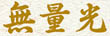
'Infinite Light'
Journal of Shin Buddhism
MUSIC
Music Inspired by the Buddha Dharma
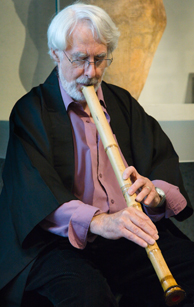
© National Gallery of Australia, Canberra
Graham Ranft
Started out in music playing jazz double bass, now playing flute,traverso and recorders.
The Pure Land Pieces
These pieces have been created using a computer program called Musicnum. I have tried to capture the essence of Pure Land Buddhism - tranquillity, peace and with a feeling of spaciousness.
PL1
was my first attempt.
[Duration: 10:00]
PL1 with alto flute
PLI with alto flute melody.
[Duration : 5:11]
PLII
is a musical representation of the 'Pureland'.
[Duration: 10:00]
PLIII
is a further refinement of PL1[Duration: 10:00]
PLIV
A new version, slower in tempo with less instruments
[Duration: 20:00] Note the
file size is approximately 18Mb
NOH-KAN FUE
I recorded 'Oshirabe' in the Old Parliament House in Canberra and the reverberation is quite natural. Oshirabe is played before the Noh play begins in the "mirror room" where the actors don their costumes and the musicians 'warm up' and assemble their drums. The piece is both an introduction and a warm up piece.
This an introductory piece played at the entrance of a Warrior Shite [main character].
SHAKUHACHI
Towa no wakare no aika 永遠の別れの哀歌 - Version played at Tsunami Earthquake Memorial March 11 2013
Akibare 秋晴れ A calm clear sunny autumnal day: played on a 1.8 in a Tozan Ryu style.
Invocation of the Name. This piece comes from the heart ...yearning for escape and enlightenment, only to realise we have to accept ourselves as we are and in doing so comes serenity and the beginning of real practice.
Shikantaza,
or 'just sitting,'
is alert nonselective attention which neither pursues nor suppresses
thoughts, sensations, etc., but, rather, gives alert detached attention
to whatever arises in and vanishes from consciousness. [Duration: 04:07]

Koku is a much venerated piece. It is played by all schools of shakuhachi playing and its common title is 'Empty Sky' this refers to the concept of Sunyata. Daishihan Riley Lee writes ...'It refers to a concept that is in the realm of the Absolute and therefore cannot be explained or understood with words. Words, and indeed our thoughts, are of the world of the relative. For example, the word "empty" has no meaning apart from the word "full". The work "ko", on the other hand, does not mean merely "empty", because it is not the opposite of "full"; it is "that" which has nothing to do with "fullness".' The player aims to attain the ulitimate state of enlightenment whilst playing this piece. [Duration: 05:27]
Towa
no wakare no aika 永遠の別れの哀歌
This literally translates as follows: towa = eternal; wakare =
separation; aika = elegy or lament, sad song, etc.
The expression towa no wakare is a euphemism for death, and the
implication, is that the person who is now 'eternally separated' was a
loved one or very close friend. Title translation courtesy Daishihan
Riley Lee
Ekoh This honkyoku came from the Ichigetsuji, in Chiba prefecture. Played on a Shugetsu Yamaguchi 2.85/F# jinashi shakuhachi.
Hachi
gaeshi (Returning the Bowl)
is performed after the monk received alms, usually a bowl of uncooked
rice. The monk would then return the bowl and perform 'Returning the
Bowl' in an expression of gratitude, for the food which gives him life,
and on the part of the donor for the opportunity to give. The temple of
Echigomeianji is in Niigata Prefecture.
Kyorei
is the oldest known shakuhachi piece, a slow quiet piece
that is both simple and very challenging to play. It is regarded as one
of the most venerated of pieces. Here it is played with 'Kyosui' -
empty breath without affectation or tecnical artifice This simple
playing style is the essence of Zen.

Hifumi
shirabe
- Hifumi means simply "1- 2- 3"
This is one of many 'searching' pieces in the classical shakuhachi
repertoire.
"The meaning of the first three characters in this context is unknown,
though
they may refer to the 'three jewels' of Buddhism". Daishihan Riley Lee.
This short piece can played as a 'way' to search for an awareness of
one's present situation. Played 'Kyotaku' style on a 2.85 shakuhachi.
Yamato
choshi
"This version of Choshi is believed to have originated in the
Yamato district of old Japan, what is now the Nara region,
the site of the first capital of Japan, 13 centuries ago. The Zen
tradition of shakuhachi holds that the shakuhachi
plays you as much as you play the shakuhachi. This is a renewing of
this relationship between the
bamboo and the person". Daishihan Riley Lee Played in the 'Kyotaku' way
on 2.85 shakuhachi.

Honte Choshi (calligraphy, right), 'Original Searching' - a short prelude style of piece. It serves to help establish the pitch of the instrument and to center the musician. The musician warms up and then settles the mind for spiritual practice through the playing of such a piece. Often refered to as 'Suizen' - Blowing Zen. A high degree of 'one pointedness' or concentration of the mind can be obtained by playing the shakuhachi.
Banshiki
This piece when played on a 1.9 shakuhachi plays the exact tones of
'banshiki' scale or mode.
The piece is associated with autumn and has a sense of space and
sadness - wabi sabi. It is a restrained
piece and here played with Kyosui - empty breath. It is is a very
Buddhist piece; concerned
with this life journey with its attachments and feelings towards the
release of death.Here it is played on a 2.4 instrument.
Chikugo
Sashi
This comes from the Fuke temple Rinsei-ken, located in Kurume City,
Fukuoka Prefecture, in the southern island of Kyushu.This is one of a
number of 'Sashi' pieces dedicated to the Bodhisattva Kannon, Buddha of
mercy and compassion, who stays in this world of suffering to assist
those in need.
Clouds
& Mountains
Inspired by the last trip I made to the southwest of Tasmania , staying
amongst the rain-soaked, misty mountains and swirling
fogs of this wilderness area.
Takane
Sashi
Takane means 'high sound'. It may have come from Itchoken, Temple
Hakata Prefecture, on Kyushu. Played on a 1.8 shakuhachi.
Tehodoki
Reiho
Tehodoki Reiho / Initiation into the Dharma of the Bell refers to the
bell of Fuke. The word tehodoki literally means 'leading one by the
hand', that is, guiding a novice down the path - Daishihan Riley Lee.
Played on a 1.8 shakuhachi.
I would like here to acknowledge my deep gratitude to my teacher, Daishihan - Grand Master- Riley Lee, and also to Tilo Burdach and Bill Shozan Schultz.